Kevin Pillar can say with sincerity that he got the most out of his body in his 13-year MLB career. Pillar is best known for his toughness (remember the black eye he got after being hit by a pitch with the Mets?) and his defense. He never won a Gold Glove Award but in 2016 he was voted a Fielding Bible Award winner in center field, edging out Kevin Kiermaier in a close vote.
Kevin is currently a broadcaster for the Blue Jays, a recreational farmer, and a co-host of two podcasts, To The Majors and Blue Bird Territory. He’s enjoying retired life and being a dad while living in Argyle, Tx., a suburb of Dallas.
We talked with Kevin about his career and his defensive excellence in a conversation earlier this week.
You’re now two years removed from your career ending. Particularly with regards to the way that you played, how do you look back on it?
Extremely proud. When you’re in it, you feel like you’re never gonna be out of it. And then when you’re out of it all you do is think about it for a little bit, and then when time goes on, it almost feels like another life.
This is really the first full year that I’ve been out of baseball, because last year I got released in June. I still went to spring training, I still had opening day. I still did those things. And, I got a little bit of a summer off. Going through a full calendar year of not having to pick up and go to spring, not having an Opening Day honestly, it feels like another lifetime, a lifetime that I’m really proud of.
When I look back on some of the things that I was able to accomplish and some of the plays I was able to make, it feels like it’s another guy. I’ve been fortunate in retirement to have been able to go out and do some speaking engagements, do some events, and occasionally they’ll show a little highlight package.
It gives me goosebumps thinking about how that was me, because I don’t feel necessarily connected to that guy anymore. I’ve just moved on.
Would you have smashed your face into the fence as many times as you did if you had the opportunity to do it over?
Without a doubt, yeah. There are a couple reasons I played that way. One, being a later-round draft pick, you have this chip on your shoulder. You have the appreciation for the opportunity, and when the opportunity presents itself, you never wanna really let it go.
Me being able to go out there and play a reckless/fearless style of play really afforded me a lot of opportunities in the game. I wasn’t always super consistent with the bat. So, my defense allowed me to grow offensively and really get my feet wet and cement myself in the Major Leagues for over 10 years. So, I wouldn’t change anything about that.
Secondly, I vividly remember being a young kid either watching TV downstairs or in my bedroom and looking forward to watching Web Gems on ESPN. And I just felt like if I ever had an opportunity to go out and make a play regardless of what the scoreboard was, regardless of what the repercussions physically or mentally were gonna be, I was gonna make those plays.
You’ve broadcast games this year too.
I think when you spend a little bit of time on the bench in the last couple of years of your career, you become a little bit of an analyst anyway.
I always wanted to remind people that the game is not easy. There are times when I’ve gotten away from the game and I watch it on TV or from the booth, and it slows down tremendously. So, I do feel like when you are blessed with an opportunity to be a former player in the booth, you get to speak to a large audience about the difficulties that players face, the human side, the emotional side, the spiritual side.
I always wanna keep it real from that standpoint.
Was there anyone that you saw where you were like, “That guy kind of plays like me”?
Daulton Varsho was a pretty good guy that I watched. He’s also not a plus runner; he’s a good runner. And I was never a plus runner. So, the idea of being able to be a good center fielder without plus speed and just having good instincts, good routes, the willingness to go get it, I would say he’s a guy I watched and go, “Oh yeah, there’s some similarities there, too.”
What do you remember about 2016 specifically? That’s the year you won our Award.
I remember being good in 2015 and being up for various defensive awards without winning any and then coming back even more motivated in 2016 to just try to improve on what I already felt like was a pretty good season defensively.
I also felt with 2015 being my first full season in the big leagues, I was relying on my coaches a lot, not relying on instincts a lot, and not really having a full Rolodex of information in terms of understanding my pitching staff, understanding the guys that we were playing against, understanding tendencies and stuff.
I felt like in 2016, I had a full year of work, especially in our division, we had a lot of the same pitchers coming back. I knew how they wanted to try to attack guys. If they were gonna miss, I knew where the offensive guys were more than likely gonna hit the ball. It just felt like I took that next step defensively in terms of raw ability and athleticism and the will and guts to make plays.
I combined that with the education of the game that they gave me, and I felt like those two worlds collided and it ended up being a special year for me defensively.
What was the hardest part of playing defense?
The hardest part is just doing it every single day, keeping your body in shape to go out there and play a position that requires a lot out of you and especially playing on turf for the first couple years of my career. That’s a difficult thing to do. In baseball, at any position except for catcher, you just have to do a really good job of understanding that the pitcher really dictates the game, and the offensive player really dictates the game, so you’re not really on offense ever on defense.
You have to trick yourself to be offensively inclined on defense to be able to make plays. You can’t be on your heels out there. In center field you’re so far away from the balls, it’s easy to get on your heels out there and think the ball’s not coming to you. It’s very difficult to trick yourself into believing that the ball’s coming to you every single time.
There are a lot of highlight reels of you on YouTube from that season. Do you remember any particular plays from 2016?
Opening Day in Tampa, I went into the wall headfirst. Steve Pearce hit the ball against Brett Cecil. I remember making that play. Kevin Kiermaier (of the Rays) came off a historic year defensively too and there was definitely a rivalry there because we both thought we were the best at the position. We’ve actually become friends now. I remember feeling really good about that play in Tropicana Field going up against him.
There’s the difficulty of having to run a long distance while tracking the ball in the Trop, not really being able to take your eye off the ball because if you do, you’re likely to lose the ball there. Then, not having a traditional warning track and then just going awkwardly into the wall head and neck first. It’s scary to do that, but ultimately, I was ok. When you do those things, you know the risk and for me it was to deal with it after the fact. It was never a thought of “What if I do this, what’s going to happen?” I just wanted to make plays. That’s what I wanted to do since I was a little kid. I was fortunate enough to get the opportunity to do it. I never took that lightly.
What was the turning point for you, just life-wise, in terms of going from 32nd-round pick to making it to the Major Leagues?
There’s a series of turning points. I was very fortunate my first year in Bluefield, West Virginia to come across a wonderful man and a wonderful hitting coach by the name of Kenny Graham. I was an emotional guy. I accomplished a lot of great things in college, and then I came into pro ball as this underdog. I didn’t want pity. I wanted to work and get better, and I remember struggling my first month in rookie ball and going into his office and talking to him and cutting him off at some points and being like “I believe in myself. I know I can do great things. I know I could hit.” And he just taught me how to work properly. I was always a hard worker, but taking 1,000 swings in the cage doesn’t always mean you’re working right. He taught me routine and discipline.
The other story that I didn’t know about till later in life was I had a scout watch my first Double-A at-bat, and there was a leadoff double. And instead of trying to get a hit my first at-bat, I was trying to move the runner over to second base. And little did I know that was the day they felt like I could be a big leaguer because they knew that winning was the most important thing to me. Those couple things were probably turning points in my career.
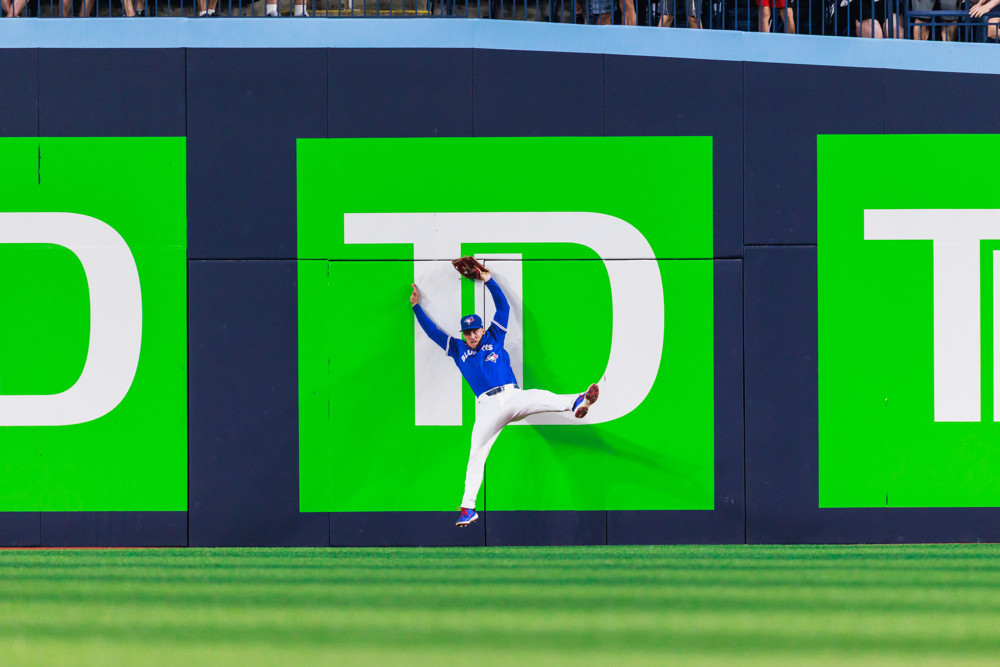
Defensively, making that play on Jackie Robinson Day really propelled me to a different point in my career.
That’s the crazy catch against Tim Beckham. Can you recount it?
I got my start in left field because Michael Saunders got hurt in spring training. More than likely, I was going to make the opening day roster as an extra outfielder. But he got hurt. That slid me up the ranks to starting position. And yeah, I’m out there playing, and I just felt like I always did a pretty good job of understanding my surroundings, and I would always go through these hypotheticals in my head, like, what if? How would I do it? How would I get up? And sure enough, the opportunity presented itself. Some things like that aren’t even conscious thoughts. They’re just reactions. They’re just going out there and trusting all the hard work and preparation you’ve done over the years, and the perfect storm of events happens.
It’s me being able to get up the wall, timing it right, but also, you have to have the right type of ball flight and distance and stuff like that, and it just really worked out where I was able to go up there and make an unbelievable play.
It didn’t necessarily change the way that I viewed myself. It changed the way that my organization viewed me as a defender. I got to the big leagues because I could hit; I played good defense along the way too, but I definitely think I got there because I could hit. So, to be able to prove to them that this 32nd-round draft pick who’s not a plus runner could play center field, yeah, that was a big moment for me.
I think it was the most important defensive play I ever made. I don’t know if it’s my favorite.
Do you have a favorite?
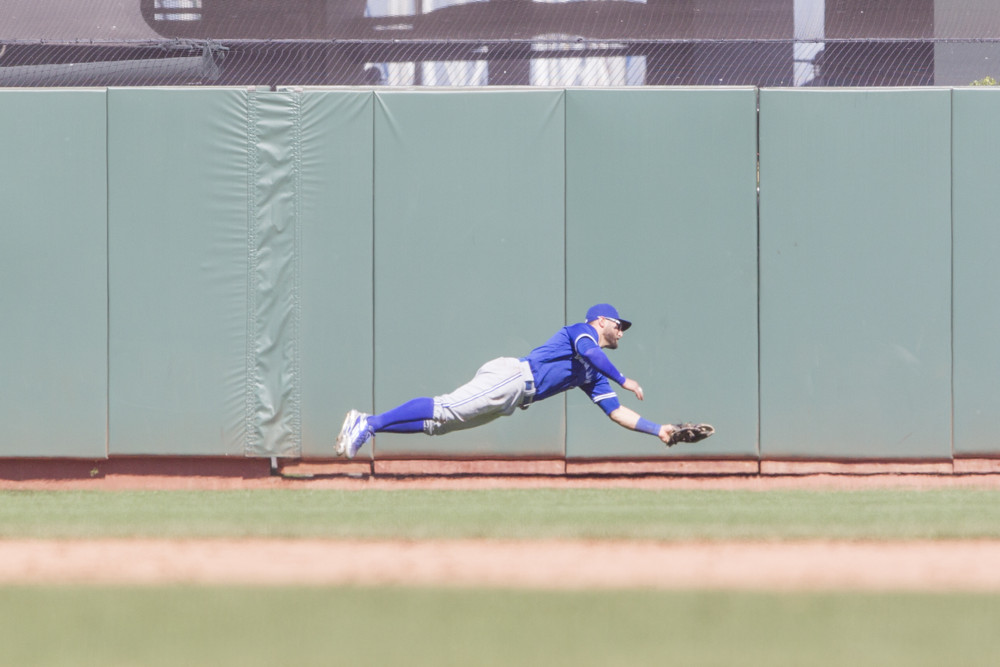
I caught a ball off Mookie Betts going into right center field gap in Toronto. Marcus Stroman was pitching, and just full extension. It landed inches before the plexiglass on the scoreboard out there, and I just think that was an incredible catch. It just sums up who I was as a defender, the combination of athleticism, the route, taking the fear factor out because you know the wall’s coming. I think that just really sums up what I was when I was at my best defensively.
How would Kevin Pillar the broadcaster, removed from his life, evaluate Kevin Pillar the player?
Great teammate. Plays the game the right way, plays hard. Offensively when he’s good, he’s really good. When he’s struggling … he struggles. You’d like to see some growth from him offensively in terms of just swing decision-making. But all in all, he’s the type of guy who helps your team win games.
To close: Since we’re in October and the holiday is a few weeks away: I know kids used to dress up as you for Halloween in tribute to your Superman-like defensive excellence. Did you have any thoughts on the Kevin Pillar Halloween costumes?
A lot of the kids who did it are young adults, and I see them at events, and they show me pictures on their phones. And there are still are kids that will dress up as me for Halloween. Does it get any cooler than that?